
Discover
Around 1650 BC, the Egyptian scribe Ahmes wrote as . Why not simply 'two fifths'?
- Egyptians wrote fractions only as sums of unit fractions
- They had no way to divide
Key idea
Fractions through history.
- Step 1Ahmes c. 1650 BCNo portrait is knownAbout 1650 BC: Ahmes's table writes 2/n as sums of unit fractions.
- Step 2Liu Hui c. 225 – c. 295No portrait is knownChina: the Nine Chapters give rules for all four operations on fractions (commentary by Liu Hui, 263).
- Step 3Fibonacci c. 1170 – c. 1250Imagined portraitUnknown artist. Public domain1202: Fibonacci's Liber abaci spreads Hindu-Arabic numerals in Europe.

The Rhind papyrus gives as unit fractions for every odd from 5 to 101. The Chinese Nine Chapters give rules to add, subtract, multiply and divide fractions. In 1202 Fibonacci's Liber abaci brought Hindu-Arabic numerals to Europe.
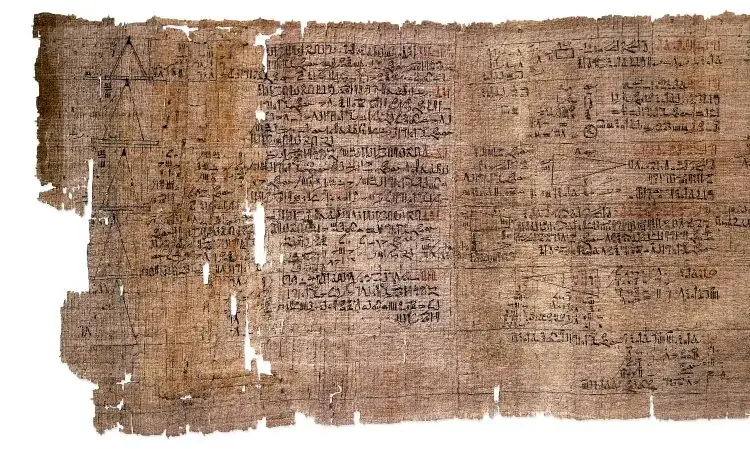
Reckon 2 divided by 5. A third of 5: 1 and 2/3. A fifteenth of 5: 1/3.

What does the scribe check in this line?
- That and of 5 make 2 together
- That 5 can be shared into 3 and 15
Worked example
Check Ahmes's line for :
Common denominator 15.
✓
simplifies by 3.
Practice ★
- How did Egyptian scribes write most fractions?
- As sums of unit fractions like 1/3 + 1/15
- As decimals
- With a fraction bar, as today
- Like Ahmes: . Find .
- Like Ahmes: . Find .
- As in the Nine Chapters: add .
Summary card
Fractions today
- Recipes, music (half and quarter notes), and sharing costs.
- Probabilities and percentages are fractions in disguise.
- Tools and screws are still measured in fractions of an inch in the US.
Sources: MacTutor articles on the Egyptian papyri and the Nine Chapters; biography of Fibonacci (see "Sources and credits").