Lessons and exercises follow the school system and stay in its language.Les leçons et les exercices suivent le système scolaire et restent dans sa langue.Lektionen und Übungen folgen dem Schulsystem und bleiben in seiner Sprache.
Every lesson of the chapter, ready for paper. Exercise sets are lettered A, B, C… and answered at the end.
To save a PDF, choose “Save as PDF” in the print dialog.
Grade 6
Dividing fractions
NicknameDate
Scan to open onlineenglish.sedifier.com/en-us/us-ma-2017/grade-6/us.g6.dividing-fractions/
1. Dividing fractions
Discover
How many 41-cup scoops are in 3 cups?
12
43
Key idea
Divide by a fraction: multiply by its reciprocal.
ba÷dc=ba⋅cd. Division answers “how many groups?” or “how much in one group?”. Dividing by a number less than 1 gives a result larger than the starting number.
Worked example
32÷54.
32⋅45
Reciprocal of 4/5.
1210=65
Multiply.
Your turn, guided
Your turn: 43÷21.
23
3/4 · 2.
Practice ★
How many 41-cup servings are in 6 cups of rice?
How many 81-cup servings are in 25 cups of rice?
Compute 31÷32.
Watch out!
Practice ★★
63 of a bag of flour weighs 15 kg. How much does the whole bag weigh (kg)?
149 of a bag of flour weighs 144 kg. How much does the whole bag weigh (kg)?
Exit ticket
Three questions to check you have got it.
Compute 31÷32.
Compute 2412÷1612.
Compute 31÷54.
Summary card
Dividing fractions
Multiply by the reciprocal of the divisor.
Watch out: flip the second fraction, not the first.
One more step is optional: a challenge. Try it, or finish the lesson now.
Challenge ★★★
Find x: 73÷x=86.
2. Area and volume with fractional lengths
Warm-up
Three quick questions from earlier lessons.
A parallelogram has a base of 9 cm, a height of 2 cm and slanted sides of 5 cm. What is its area (cm²)?
A parallelogram has an area of 12 cm² and a base of 2 cm. What is its height (cm)?
A parallelogram has a base of 9 cm. Which length is its height?
The distance between the base and the opposite side, measured at a right angle
The length of a slanted side
The longest side
Discover
A rectangle is 21 m by 31 m. Its area is what part of a square meter?
61
65
Key idea
Area and volume formulas work with fractions too.
Area of a rectangle =ℓ⋅w and volume of a box =ℓ⋅w⋅h also for fractional lengths: multiply numerators and denominators. A unit cube holds k3 cubes of edge k1.
Worked example
A box 21 by 3 by 32.
21⋅3⋅32=1 cubic unit
Multiply.
Your turn, guided
Your turn: a square with side 43. Its area.
169
3/4 · 3/4.
Practice ★
A rectangle is 51 m by 52 m. What is its area (m²)?
A rectangle is 54 m by 65 m. What is its area (m²)?
A box is 21 ft by 7 ft by 31 ft. What is its volume (ft³)?
Watch out!
Practice ★★
How many cubes with edge 21 unit fill a box 1 by 2 by 1 units?
How many cubes with edge 41 unit fill a box 4 by 3 by 4 units?
Exit ticket
Three questions to check you have got it.
A rectangle is 51 m by 52 m. What is its area (m²)?
A rectangle is 54 m by 65 m. What is its area (m²)?
A rectangle is 61 m by 32 m. What is its area (m²)?
Summary card
Fractional lengths
Multiply lengths for areas and volumes, fractions included.
Watch out: a 1/k cube is 1/k³ of a unit cube.
One more step is optional: a challenge. Try it, or finish the lesson now.
Challenge ★★★
A rectangle has area 85 m² and width 21 m. What is its length (m)?
3. The mediant of two fractions
Discover
Add the tops and add the bottoms: 31 and 21 give 52. That is wrong for addition, but where is 52 compared with 31 and 21?
Between them
It is their sum
Key idea
The mediant of two fractions.
For ba<dc (with b,d>0), the mediantb+da+c lies strictly between them. It is a quick way to find a fraction between two others.
Worked example
Find a fraction between 53 and 32.
5+33+2=85
Mediant.
85 is between them
Check: 0.6<0.625<0.667.
Your turn, guided
Your turn: find the mediant of 41 and 21.
62=31
4+21+1.
Practice ★
Find the mediant of 81 and 74.
Find the mediant of 54 and 83.
Find the mediant of 71 and 54.
Practice ★★
A player scored 1 goal in 7 shots in game 1 and 1 goal in 9 shots in game 2. What fraction of all shots were goals?
A player scored 1 goal in 2 shots in game 1 and 1 goal in 4 shots in game 2. What fraction of all shots were goals?
Exit ticket
Two questions to check.
Find the mediant of 81 and 74.
Find the mediant of 54 and 83.
Summary card
Mediant
b+da+c lies between ba and dc.
It is NOT the sum of the fractions.
A batting average over two games is a mediant of the two single-game averages.
4. History of fractions: Egypt, China and Fibonacci
Discover
Around 1650 BC, the Egyptian scribe Ahmes wrote 52 as 31+151. Why not simply 'two fifths'?
Egyptians wrote fractions only as sums of unit fractions n1
They had no way to divide
Key idea
Fractions through history.
Step 1AAhmesc. 1650 BCNo portrait is knownAbout 1650 BC: Ahmes's table writes 2/n as sums of unit fractions.
Step 2LLiu Huic. 225 – c. 295No portrait is knownChina: the Nine Chapters give rules for all four operations on fractions (commentary by Liu Hui, 263).
Step 3Fibonaccic. 1170 – c. 1250Imagined portraitUnknown artist. Public domain1202: Fibonacci's Liber abaci spreads Hindu-Arabic numerals in Europe.
The Rhind papyrus gives n2 as unit fractions for every odd n from 5 to 101. The Chinese Nine Chapters give rules to add, subtract, multiply and divide fractions. In 1202 Fibonacci's Liber abaci brought Hindu-Arabic numerals to Europe.
Source
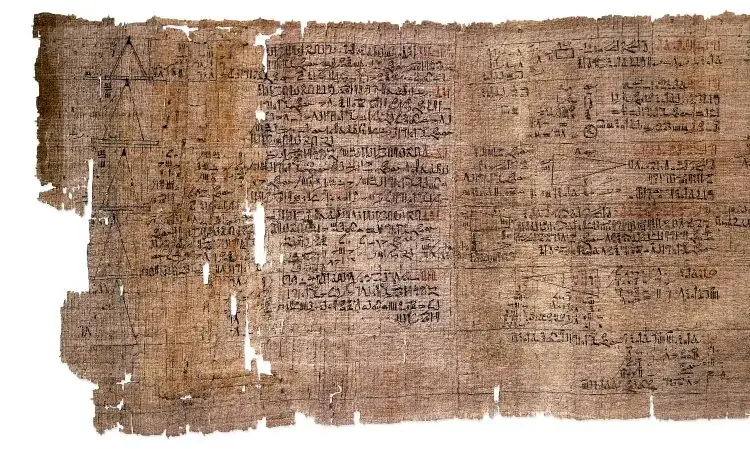
Reckon 2 divided by 5. A third of 5: 1 and 2/3. A fifteenth of 5: 1/3.
Rhind papyrus, table of 2/n, copied by the scribe Ahmes about 1650 BC (our simplified transcription)Rhind Mathematical Papyrus (detail), the scribe Ahmes (copy), about 1650 BC. British Museum, London. Public domain
What does the scribe check in this line?
That 31 and 151 of 5 make 2 together
That 5 can be shared into 3 and 15
Worked example
Check Ahmes's line for 52:
31+151=155+151
Common denominator 15.
=156=52 ✓
156 simplifies by 3.
Practice ★
How did Egyptian scribes write most fractions?
As sums of unit fractions like 1/3 + 1/15
As decimals
With a fraction bar, as today
Like Ahmes: 242=161+x1. Find x.
Like Ahmes: 272=181+x1. Find x.
As in the Nine Chapters: add 51+91.
Summary card
Fractions today
Recipes, music (half and quarter notes), and sharing costs.
Probabilities and percentages are fractions in disguise.
Tools and screws are still measured in fractions of an inch in the US.
Sources: MacTutor articles on the Egyptian papyri and the Nine Chapters; biography of Fibonacci (see "Sources and credits").
Answers: Dividing fractions
1. Dividing fractions
A
24
200
B
0.5
C
30
224
D
0.5
32
125
E
74
2. Area and volume with fractional lengths
A
18
6
The distance between the base and the opposite side, measured at a right angle
B
0.08
32
C
67
D
16
3072
E
0.08
32
91
F
45
3. The mediant of two fractions
A
31
137
125
B
81
31
C
31
137
4. History of fractions: Egypt, China and Fibonacci