Lessons and exercises follow the school system and stay in its language.Les leçons et les exercices suivent le système scolaire et restent dans sa langue.Lektionen und Übungen folgen dem Schulsystem und bleiben in seiner Sprache.
Every lesson of the chapter, ready for paper. Exercise sets are lettered A, B, C… and answered at the end.
To save a PDF, choose “Save as PDF” in the print dialog.
Grade 6
Expressions and equations
NicknameDate
Scan to open onlineenglish.sedifier.com/en-us/us-ma-2017/grade-6/us.g6.expressions-equations/
1. One-step equations
Discover
A balance has x and 4 weights on one side and 11 weights on the other. What is x?
7
15
Key idea
Undo the operation on both sides.
An equation stays true if you do the same to both sides. Undo adding by subtracting, subtracting by adding, multiplying by dividing, dividing by multiplying.
Worked example
5x=35 and x−8=12.
x=7
Divide by 5.
x=20
Add 8.
Your turn, guided
Your turn: x+9=23.
14
23 − 9.
Practice ★
Solve x+8=36. x=?
Solve x+223=509. x=?
Solve 4x=12. x=?
Watch out!
Practice ★★
Solve 3x=5. x=?
Solve 21x=25. x=?
Exit ticket
Three questions to check you have got it.
Solve x+8=36. x=?
Solve x+223=509. x=?
Solve x+4=31. x=?
Summary card
One-step equations
Do the opposite operation to both sides.
Watch out: undo × with ÷ and ÷ with ×.
One more step is optional: a challenge. Try it, or finish the lesson now.
Challenge ★★★
I think of a number. I divide it by 4, then add 3. I get 12. What is my number?
2. Solve linear inequalities in one variable
Warm-up
Three quick questions from earlier lessons.
A rectangle has sides x+5 and 4x−1. Its perimeter is 2(x+5)+2(4x−1).
Simplified, the perimeter is ?x+?. The coefficient of x: ?
The constant term: ?
The perimeter is 98. Solve for x: ?
Length of the side 4x−1:
The largest whole number x for which the perimeter is at most 118:
Solve 3x+1=13. x=?
Solve 4x+8=3x+12. x=?
Discover
−2x>6. Try x=−4: −2⋅(−4)=8>6. So which describes all solutions?
x<−3
x>−3
Key idea
Solve inequalities like equations, with one extra rule.
Adding, subtracting, multiplying or dividing by a positive number keeps the inequality. Multiplying or dividing by a negative number flips it. Strict signs (<, >) exclude the endpoint; ≤, ≥ include it.
Worked example
Solve −3x+4≤13.
−3x≤9
Subtract 4.
x≥−3
Divide by −3: flip.
[−3,∞)
Endpoint included.
Your turn, guided
Your turn: 2x−1<9. The boundary value of x.
x<5
2x < 10.
Practice ★
Solve 3x+17<41. Give the solution set as an interval.
Solve 18x+28<388. Give the solution set as an interval.
You have 52 dollars and tickets cost 5 dollars each. Solve 5t≤52: what is the greatest number of tickets you can buy?
Watch out!
Practice ★★
Solve −3x+7≤−17. Give the solution set as an interval.
Solve −11x+24≤299. Give the solution set as an interval.
Exit ticket
Three questions to check you have got it.
Solve 3x+17<41. Give the solution set as an interval.
Solve 18x+28<388. Give the solution set as an interval.
Solve 3x+1<10. Give the solution set as an interval.
Summary card
Inequalities
Solve as an equation; flip when multiplying or dividing by a negative.
Watch out: check with a number from your answer.
One more step is optional: a challenge. Try it, or finish the lesson now.
Challenge ★★★
How many integers x satisfy 4≤x+9<18?
3. Equivalent expressions: distributing and combining like terms
Warm-up
Three quick questions from earlier lessons.
Compute 5+(−15).
Compute −2−9.
Compute 8−(−7).
Discover
Is 10−(3+2) the same as 10−3+2?
No
Yes
Key idea
Equivalent expressions are equal for every value of the variable.
Distribute:a(b+c)=ab+ac, also with minus signs: −(b−c)=−b+c. Combine like terms by adding their coefficients, keeping each term's sign: 5x−2x=3x. Think of subtraction as adding the opposite.
Worked example
Simplify 6x−2(x−4)+1.
6x−2x+8+1
−2 times each term.
4x+9
Combine.
Your turn, guided
Your turn: the coefficient of x in 7x+3−2x.
5
7 − 2.
Practice ★
Write 4(x−2) without parentheses. What is the constant term?
Write 10(x−14) without parentheses. What is the constant term?
Combine like terms in 9x+9−8x+3. What is the coefficient of x?
Watch out!
Practice ★★
Simplify 6x−(1x−6). What is the constant term?
Simplify 36x−(21x−11). What is the constant term?
Exit ticket
Three questions to check you have got it.
Write 4(x−2) without parentheses. What is the constant term?
Write 10(x−14) without parentheses. What is the constant term?
Write 4(x−3) without parentheses. What is the constant term?
Summary card
Equivalent expressions
Distribute to every term; combine like terms with their signs.
Watch out: a minus before parentheses changes every sign inside.
One more step is optional: a challenge. Try it, or finish the lesson now.
Challenge ★★★
Find the number a such that 2(x−a)+1 equals 2x−9 for every x.
4. Expressions with exponents; order of operations
Warm-up
Three quick questions from earlier lessons.
Write 4(x−2) without parentheses. What is the constant term?
Combine like terms in 9x+9−8x+3. What is the coefficient of x?
Simplify 6x−(1x−6). What is the constant term?
Discover
What is 34?
81
12
Key idea
Exponents mean repeated multiplication; they come first.
bn means n factors of b: b⋅b⋯b. Order of operations: parentheses, then exponents, then multiplication and division, then addition and subtraction. In 3x2 only x is squared.
Worked example
Evaluate 2+3⋅42.
42=16
Exponent first.
3⋅16=48
Multiply.
50
Add.
Your turn, guided
Your turn: 5x2 when x=3.
45
5 · 9.
Practice ★
What is the value of 32?
What is the value of 53?
Evaluate 1+3⋅32.
Watch out!
Practice ★★
Evaluate 2x2 when x=3.
Evaluate 6x2 when x=17.
Exit ticket
Three questions to check you have got it.
Evaluate 1+3⋅32.
Evaluate 50+4⋅92.
Evaluate 1+2⋅32.
Summary card
Expressions with exponents
Parentheses, exponents, × ÷, + −.
Watch out: in kx² only x is squared.
One more step is optional: a challenge. Try it, or finish the lesson now.
Challenge ★★★
Find the whole number n such that 2n=128.
5. Proportional relationships: y = kx
Discover
3 pounds of apples cost 6 dollars. At the same price, what do 5 pounds cost?
10 dollars
8 dollars
Key idea
Proportional means y=kx.
In a proportional relationshipy=kx, where k=xy is the constant of proportionality (the unit rate). Its graph is a line through the origin, and k is the slope.
Worked example
A printer prints 45 pages in 3 minutes.
k=15 pages per minute
45 ÷ 3.
y=15x
Equation.
120 pages in 8 minutes
x = 8.
Your turn, guided
Your turn: y is proportional to x, and y=28 when x=4. Find k.
7
28 ÷ 4.
Practice ★
y is proportional to x. When x=4, y=12. Find the constant of proportionality k in y=kx.
y is proportional to x. When x=21, y=273. Find the constant of proportionality k in y=kx.
Which equation represents a proportional relationship?
y=2x
y=2x+9
y=x+2
Watch out!
Practice ★★
A train travels 6 miles in 2 minutes at a constant speed. How far does it travel in 10 minutes?
A train travels 450 miles in 15 minutes at a constant speed. How far does it travel in 29 minutes?
Exit ticket
Three questions to check you have got it.
y is proportional to x. When x=4, y=12. Find the constant of proportionality k in y=kx.
y is proportional to x. When x=21, y=273. Find the constant of proportionality k in y=kx.
y is proportional to x. When x=2, y=8. Find the constant of proportionality k in y=kx.
Summary card
Proportional relationships
y=kx, k=y÷x; the graph passes through (0,0).
Watch out: scale by multiplying, not by adding.
One more step is optional: a challenge. Try it, or finish the lesson now.
Challenge ★★★
y is proportional to x. If x increases by 25 %, by what percent does y increase?
6. Three equations, three unknowns
Discover
A café sells a coffee, a juice and a muffin. Two of you know the totals of three different orders. Can three equations pin down three prices?
Yes, usually
No, two unknowns at most
Key idea
Three equations, three unknowns.
Eliminate one unknown to get two equations in two unknowns, then eliminate again to get one equation in one unknown. Solve it and substitute back, step by step.
Worked example
Solve x+y+z=10, x+y=7, y+z=8.
z=10−7=3
Subtract the second equation from the first: the x and y disappear.
y=5
Put z=3 in y+z=8.
x=2
Put y=5 in x+y=7.
Your turn, guided
Your turn: x+y+z=12 and y+z=9. What is x?
x=3
Subtract the second equation from the first.
Practice ★
Solve x+y+z=17 and y+z=13. What is x?
Solve x+y+z=19 and y+z=13. What is x?
Solve x+y+z=20 and y+z=11. What is x?
Practice ★★
Solve x+y+z=19, x+y=14 and y+z=10. What is y?
Solve x+y+z=7, x+y=2 and y+z=6. What is y?
Exit ticket
Two questions to check.
Solve x+y+z=17 and y+z=13. What is x?
Solve x+y+z=19 and y+z=13. What is x?
Summary card
Three unknowns
Subtract or add equations to remove one unknown.
Repeat until one unknown is left, then substitute back.
Computers solve systems with thousands of unknowns the same way.
7. History of equations: from Ahmes to al-Khwarizmi
Discover
Around 1650 BC in Egypt, the scribe Ahmes copied a scroll of problems that was already 200 years old. Problem 24 asks: a quantity and a quarter of it make 15. What is the quantity?
Guess a convenient number, then correct it
Write x+4x=15 and solve with letters
Key idea
Three ways of solving, three places, three times.
Step 1AAhmesc. 1650 BCNo portrait is knownAbout 1650 BC: Ahmes copies a 6-meter scroll of problems. He solves equations by false position.
Step 2LLiu Huic. 225 – c. 295No portrait is knownChina: the Nine Chapters (246 problems) solve systems with tables of numbers. Liu Hui writes his commentary in AD 263.
Step 3al-Khwarizmic. 780 – c. 850Imagined portraitZarateman (photograph), 2022. Zarateman. CC0 1.0Baghdad, House of Wisdom: al-Khwarizmi's book on 'completion and balancing' gives us the word algebra. He writes only in words.
False position (Egypt): try 4. Then 4+1=5, but we want 15, which is 3 times as much, so the quantity is 3×4=12.
Balancing (Baghdad): do the same thing to both sides until the unknown stands alone, as we still do today.
Source
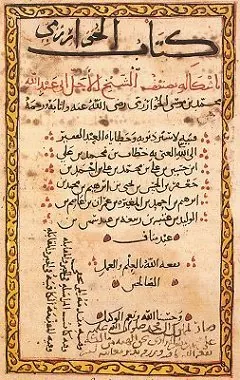
One square, and ten roots of the same, amount to thirty-nine dirhems.
Al-Khwarizmi, The Compendious Book on Calculation by Completion and Balancing, Baghdad, about 820, in the translation by Frederic Rosen (1831, public domain)Page from a manuscript of al-Khwarizmi's book of algebra (al-Kitāb al-mukhtaṣar fī ḥisāb al-jabr wa-l-muqābala), al-Khwarizmi (text). Public domain
How does al-Khwarizmi write this equation?
In words, with no symbols
With letters, as x2+10x=39
Worked example
The Chinese Nine Chapters set systems out as tables of numbers and removed one unknown after the other. Our version:
Subtract the second from the first
Two equations: 2x+y=11 and x+y=7.
x=4, then y=3
The y disappears, as in the Chinese tables.
Practice ★
The word algebra comes from the title of al-Khwarizmi's book. What did his al-muqabala, 'balancing', mean?
Removing equal terms that appear on both sides
Writing the unknown with the letter x
Weighing goods on market scales
Like Ahmes: a quantity and a quarter of it make 50. Try 4 first (4 and its quarter make 5), then correct. What is the quantity?
Like Ahmes: a quantity and a quarter of it make 55. Try 4 first (4 and its quarter make 5), then correct. What is the quantity?
As in the Nine Chapters: 2 bundles of rice and 1 bundle of millet weigh 13 units, 1 of rice and 1 of millet weigh 11. How much does a bundle of rice weigh?
Summary card
Linear equations today
Spreadsheets and phone plans: total cost = fixed part + price × quantity.
Mixtures in chemistry and cooking: systems of equations find the amounts.
Computers solve systems with millions of unknowns, for weather forecasts and 3D graphics, by the elimination the Nine Chapters already used.
Sources: MacTutor articles on the Egyptian papyri, the Nine Chapters and al-Khwarizmi (see "Sources and credits").
Answers: Expressions and equations
1. One-step equations
A
28
286
B
3
C
15
525
D
28
286
27
E
36
2. Solve linear inequalities in one variable
A
a) 10 b) 8 c) 9 d) 35 e) 11
4
4
B
(−∞,8)
(−∞,20)
C
10
D
[8,∞)
[−25,∞)
E
(−∞,8)
(−∞,20)
(−∞,3)
F
14
3. Equivalent expressions: distributing and combining like terms
A
−10
−11
15
B
−8
−140
C
1
D
6
11
E
−8
−140
−12
F
5
4. Expressions with exponents; order of operations
A
−8
1
6
B
9
125
C
28
D
18
1734
E
28
374
19
F
7
5. Proportional relationships: y = kx
A
3
13
B
y=2x
C
30
870
D
3
13
4
E
25
6. Three equations, three unknowns
A
4
6
9
B
5
1
C
4
6
7. History of equations: from Ahmes to al-Khwarizmi